
New cooling technique could help reveal physics beyond the Standard Model
Colorado-based researchers have reduced the systematic uncertainty in their optical lattice clock to a record low. Ali Lezeik explains how they did it
The behaviour of photons confined inside three-dimensional cavity superlattices is much more complex than that of electrons in conventional solid-state materials
System charts the evolution of complex quantum states
Tokamaks like ITER could benefit from computer modelling results
System could be used to simulate superconducting bilayer graphene
Molecules cooled to their quantum ground state
Magnetosphere events known as whistler mode chorus emissions can now be produced in a controlled environment
Removing "noise" from atomic motion enables scientists to observe electron movement in real time, leading to new interpretations of previous results

An open-access journal providing authors with a rapid platform for communicating high-quality research in all areas of physics. As well as being indexed in Scopus, Journal of Physics Communications offers authors fast publication, rigorous peer review, and welcomes multidisciplinary studies.
 Read article: Scientists identify a ‘sugar world’ beyond Neptune
The surface of a Kuiper Belt object called Arrokoth is rich in glucose, ribose and other sweet molecules
 Read article: Space-borne atoms herald new tests of Einstein’s equivalence principle
Measuring the free-fall rate of different type of atoms in space could unveil hidden mechanisms of gravity
 Read article: Matter–antimatter gas of positronium is laser cooled
Technique could give spectroscopic studies of antimatter a boost
 Read article: Ultracold four-atom molecules are bound by electric dipole moments
New technique could shed light on high-temperature superconductivity
 Read article: Physicists take the temperature of second sound
Results could have applications for studies of high-temperature superconductors and neutron stars
 Read article: Physicists observe false vacuum decay in a ferromagnetic superfluid
First experimental evidence of true vacuum “bubbles” could have implications for cosmology as well as condensed-matter physics
 Read article: Machine learning takes hassle out of cold-atom experiments
Reinforcement learning can make cooling apparatus more robust
 Read article: Magnetic reconnection in space and fusion plasmas: challenges at large and small scales
Join the audience for a live webinar on 6 February 2024 sponsored by IOP Publishing's journal, Plasma Physics and Controlled Fusion
 Read article: Entangled molecules make a novel qubit platform
Two independent groups report a new tool for quantum science
 Read article: Scientists propose super-bright light source powered by quasiparticles
A new light source concept based on plasma accelerators could be harnessed for a variety of applications, including non-destructive imaging and computer-chip manufacturing
 Read article: Neutral-atom quantum computers are having a moment
Three new studies show record low error rates and a new error erasure strategy for two-qubit quantum gates
 Read article: Organic molecule from trees excels at seeding clouds, CERN study reveals
Sesquiterpene creates cloud-forming particles
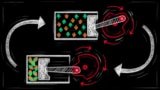 Read article: No-heat quantum engine makes its debut
Researchers demonstrate a prototype engine powered by the quantum statistics of bosons and fermions
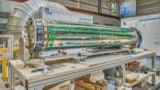 Read article: Antimatter does not fall up, CERN experiment reveals
ALPHA-g is first to observe antihydrogen in freefall
 Read article: ‘Alice rings’ spotted in a Bose–Einstein condensate
Laboratory experiment could shed light on cosmological questions
 Read article: Cold atoms used to create reliable pressure gauge for ultrahigh vacuum
Device could be used in particle accelerators and gravitational-wave detectors
 Read article: Quantum superchemistry emerges in the laboratory
Chemical reactions speed up when reactants are in the same quantum state, confirming theoretical predictions
 Read article: Physicists measure the electron electric dipole moment to unprecedented precision
Measurement calls into question theories beyond the Standard Model